Fleet Adoption Supports the IEA Story
By Ed Pierce, Editor, Fleet Management Weekly
August 27, 2025
 In its most recent 2025 EV market report, the International Energy Agency (IEA) expressed confidence that the electric car revolution remains “on track.” In its Global EV Outlook 2025, the agency projects worldwide EV sales surpassing 20 million this year, accounting for roughly one-quarter of all new car sales. Much of that momentum is coming from China and Europe.
But does the U.S. market support the same conclusion—or run counter to it? The answer is mixed: American sales are expanding but at a slower, bumpier pace than global leaders. Fleet sales—particularly in government and select commercial sectors—are increasingly aligning with the IEA’s optimism, though hybrids remain the stronger bridge technology.
U.S. Sales: Growth With a Limp
In 2024, U.S. plug-in sales (battery electric and plug-in hybrid) hit a record of more than 1.5 million units, capturing 9.9% of the market, according to Atlas EV Hub. Through July 2025, cumulative sales reached about 872,000, with July’s share at 9.85%—flat compared to last year.
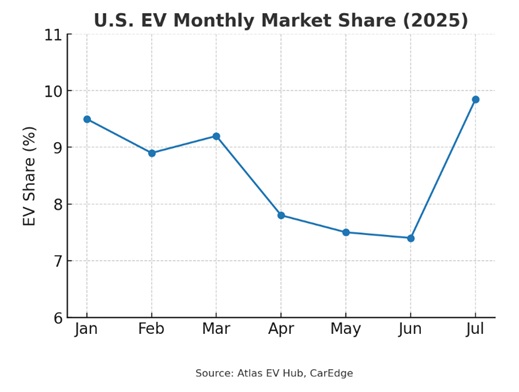
U.S. EV market share has been volatile in 2025, dipping to 7.4% in June before rebounding to nearly 10% in July. The data shows growth is uneven, not reversing—a sign of a maturing but still price-sensitive market. (Source: Atlas EV Hub, CarEdge)
Market softness in Q2, particularly at Tesla, raised concerns about stalling momentum. Yet July brought a rebound, fueled by the launch of lower-priced models such as GM’s Chevrolet Equinox EV. GM alone moved more than 19,000 EVs that month, with 8,500 of them Equinoxes.
“U.S. growth is happening in fits and starts,” BloombergNEF observed in its July outlook, noting that while the U.S. is still expanding EV volumes, it lags far behind global pacesetters.
The Year Ahead: Policy Whiplash
The following 12 months will likely bring volatility. In July, Congress ended the Section 30D new-EV consumer credit and Section 45W commercial credit effective September 30, 2025. That decision is expected to pull sales forward into the third quarter before causing a sharp dip in Q4 and early 2026.
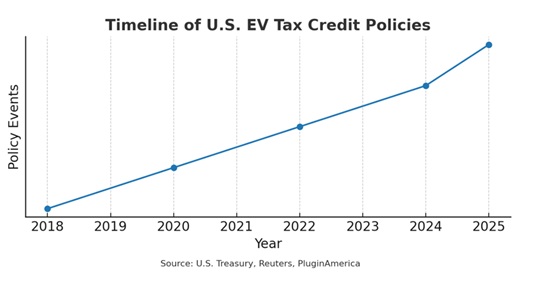
Federal EV incentives that have underpinned growth since 2010 are scheduled to expire on September 30, 2025, including credits for new EVs (30D), used EVs (25E), and commercial fleets (45W). Expect a pre-deadline sales surge followed by a possible dip as buyers and fleets race to secure remaining credits. (Source: U.S. Treasury, Reuters, PluginAmerica)
Even so, BloombergNEF forecasts U.S. passenger EV sales climbing to roughly 1.6 million this year, with growth continuing toward 4.1 million by 2030—albeit at a slower trajectory than previously expected.
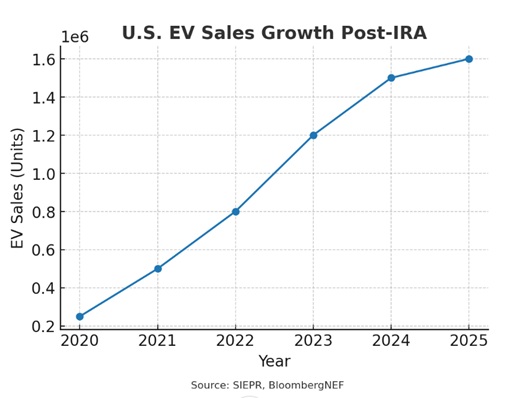
The Inflation Reduction Act (IRA) provided steady policy support, keeping U.S. EV sales on an upward track—reaching 1.5M units in 2024 and projected to exceed 1.6M in 2025. Policy stability, not sudden surges, has anchored long-term growth. (Source: SIEPR, BloombergNEF)
The model mix will be crucial. “The Equinox EV’s July sales show that sub-$35,000 vehicles can ignite demand,” said an S&P Global Mobility analyst. Infrastructure, however, remains a headwind. Some 32 federally funded charging projects were canceled this spring, though the Federal Highway Administration has since revised guidance for NEVI program funds to get stalled projects back on track.
Fleet Adoption: Backing the IEA Story
Where the U.S. consumer market shows uneven progress, North American fleets are providing firmer support for the IEA’s optimism.
According to S&P Global Mobility, U.S. commercial EV registrations have surged from about 4,000 in 2019 to nearly 87,000 in 2024. Growth in hybrids is even stronger, underscoring the role of transitional technology for fleets balancing cost, duty cycles, and charging availability.
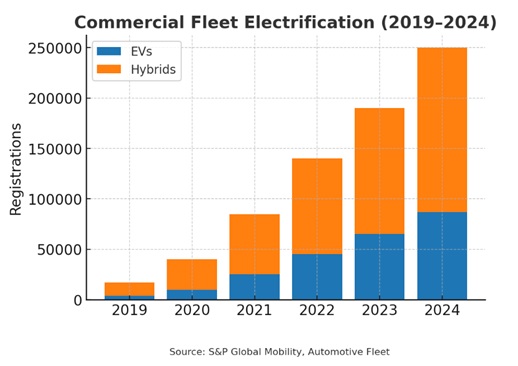
Commercial fleet EV registrations rose 20-fold since 2019, from 4,000 to 87,000 vehicles. Hybrids climbed even faster, reflecting fleets’ preference for a “bridge technology” while charging infrastructure scales up. (Source: S&P Global Mobility, Automotive Fleet)
Government fleets are stepping up as well. The U.S. General Services Administration reported 5,800 zero-emission vehicles ordered in fiscal year 2023 and another 4,000 in just the first quarter of FY2024—representing 20% of all federal vehicle orders and nearly 30% of light-duty acquisitions. The U.S. Postal Service is moving ahead with tens of thousands of EV orders as part of its fleet overhaul.
 Canada is going further: Ottawa now requires 100% of new light-duty federal fleet purchases to be zero-emission starting in 2025, impacting a federal fleet of about 40,000 vehicles. While Canada’s overall market has softened in early 2025, its policy direction for fleets is unequivocally pro-EV.
Outlook: Uneven but Directionally Positive
Globally, the IEA’s claim holds: EV sales are accelerating at a record pace, thanks to surging adoption in China and Europe. In the U.S., the trend is slower and less stable, but not contradictory. Sales are rising in volume, with policy deadlines likely to create short-term turbulence, followed by modest but continuing growth.
For North American fleets, the story is more supportive. Commercial operators are expanding EV registrations where they fit, and governments are leading adoption with firm commitments. Hybrids remain the dominant “bridge,” but the long-term trajectory is clearly aligned with electrification.
 About the author
Fleet marketing expert and consultant Ed Pierce is an editor at Fleet Management Weekly. He can be reached at 484-957-1246 or [email protected].