By Mike Sheldrick, Senior Editor
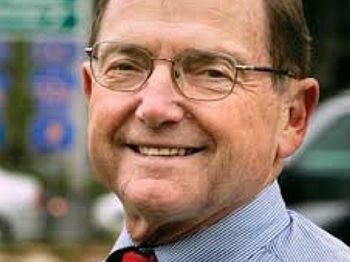
Alain Kornhauser, Ph.D. is Professor of Operations, Research and Financial Engineering at Princeton University. He is also the faculty chair of the Princeton Automated Vehicle and Engineering Group. For more than 30 years, he has been a thoughtful, insightful and often provocative thinker on advanced transportation concepts. He founded the eponymous ALK, a leading mapping and navigation and logistics company that is now a division of Trimble, a GPS pioneer.
In 2005, Alain led Princeton’s entry in the DARPA (Defense Advanced Research Projects Agency) Grand Challenge, an event that many regard as the key catalyst for efforts to make robotic vehicle technology more accessible to civilian use.
We interviewed Alain at the Automated Vehicles Symposium, held in San Francisco in July. While he offered no dates for his belief that driverless vehicles are close at hand, he articulated the compelling economics that will propel their development and adoption. One of the most intriguing notions was his idea that far from requiring elaborate, costly infrastructure, driverless vehicles could actually function autonomously in many highway environments.
Alain, please give us your thoughts on where we are today in the development of driverless vehicles.
We are at the beginning of a revolution that could be compared to going from the buggy whip to the steering wheel. The start of that process might be the Benz patent on January 29, 1886, and the real start of the whole process, to maybe March 1908 with the release of the Model T by Henry Ford.
To extend this analogy, if we say that the 2005 DARPA Grand Challenge might have been equivalent to the Benz patent, well there is not a Henry Ford out there yet. Twelve years later we were still ten years from the Model T. Can you imagine Congress in 1898 debating passing legislation and regulations associated with the automobile when the Model T was not even a gleam in Henry Ford’s eye?
Where are we today? We are still at zero. If we go outside and look around, how many even level one safe driving vehicles are out there? Essentially none. Driverless vehicles: absolute zero. Yet people are talking about creating laws and regulation and legislation. There is nothing to regulate, there is nothing out there yet.
The good news is that from zero we do have upward momentum. There are great opportunities and great reasons to do this. There are enormous financial implications; the potential safety savings are in 100s of billions. The potential financial implications of mobility are even larger — in the trillions. Economics is the driving force making this happen and the only way that it can happen is if it happens safely. You screw up the safety thing, you die!
My view is that is that it is way too early to get regulators and legislators involved. They are worried about safety. Of course, anybody in this business is also worried about safety. If they are a startup and they have a crash they have lost all of their equity. So, they know that they are betting the ranch on this technology.
Nobody is out there going crazy or doing reckless stuff. Not Waymo, Amazon or Apple. Not GM, Ford, Mercedes and the rest of the automotive OEMs.
Volvo has already said they are going to accept all of the liability associated with it. Why did they do that? Because if there is a crash, guess who the people are going to go after? They are going to go after Volvo. That is where the money is. In the end they are going to be liable, so they may as well accept it from the beginning.
Once you have accepted the inevitability of potentially massive, crippling liability you will commit to being safer than any regulations.
What will be the impact on our present infrastructure?
For many years we thought we would have to build new, advanced infrastructure as a requirement to support automated vehicles, but over the past 12 years we have learned that we can simply use the existing infrastructure and have self-driving vehicles work in a mixed environment with human drivers.
The beauty is that a mixed environment of non-automated vehicles, automated vehicles, pedestrians, and bicycles can work. We can’t get them to work completely or flawlessly, but we have achieved a proof-of-concept.
This has been done with a single vehicle, as Google’s Waymo demonstrated. It’s possible to put all your effort behind one vehicle or a handful of vehicles to drive these vehicles over a million miles. There was only one incident where Waymo’s vehicle was at fault.
Contrast that with the earlier view of what was needed. Equipping California’s highway system with advanced technology? This is just not going to happen.
So, that has been the beauty of the developments thus far. That and proof that it can be done with basically a very small budget. What did Google have? Fifty people maybe at a cost of perhaps 15 million bucks a year? That’s not even a rounding error on their balance sheet. In a very real sense, it is chump change to get the concept going. That has gotten a lot of people thinking that maybe we could actually do it on a much larger scale.
So, let’s talk about the first level, the safe driving vehicles, and their payoff to fleets.
First, safe driving vehicles are basically vehicles that have automated collision avoidance and automated lane keeping. What is driving? Finding the lane you want to be in and staying in it and not hitting anything. These are the important things to be done.
Basically, the safe-driving system watches over everything you are doing. In the case of braking, it does the right thing, much the same as the antilock brake system does: The system watches you push the brake to the floor, and it says “I am not going to let you put the brakes to the floor because the coefficient of static, i.e., rolling friction, is greater than the coefficient of kinetic, sliding friction. I’ll pump them for you — better than you could have done yourself.” It brings you to a much safer stop than you could have made, avoiding a collision.
If I go around the corner too fast, the electronic stability control system takes over and basically jiggles the throttle and brake and doesn’t let me lose my rear end. Automated braking should be on all vehicles. Automated lane keeping should be on all vehicles.
These technologies are especially important in the fleet world, where driving is essentially the most dangerous occupation there is. Fleet drivers need the kind of help that backs them up in case they weren’t paying attention to something else for a second or two.
If you’re a fleet manager, you realize there’s enormous liability associated with your fleet. The proven technology we have today to promote safer car and truck operation — automated emergency braking and automated lane-keeping, can reduce that liability through saving lives, reducing injuries and property loss.
There have been some studies on this with transit bus companies. In Washington State, they found the payback period on the technology is in the order of three years on a bus that has a 12-year life, which means that after three years it just generates cash.
With a little bit more technology, these functions will work even better and that is really what we want to put out there.
Now, the second level: The self-driving vehicle.
My second level is more self-driving where the driver can take his or her hands off the wheel and relax a little bit. Let’s provide that when our sensors and algorithms in my level one definition are good enough. This second level advanced mode delivers comfort and convenience, and quite possibly it will improve productivity of fleet drivers.
This is a win-win. We improve the work environment for drivers while we are reducing the rate of driving errors and subsequent collisions. The fleet owner could get greater productivity from its workers along with reduced risk and costs.
Call me an idealist, but that might make it possible to reduce the hours of service so that these folks can do an even better job of providing for their families and being more productive. Society wins because there are fewer injuries and deaths, fewer collision repairs, and the employers win by reduced costs and productivity gains.
Which brings us to the third level — driverless vehicles.
It’s not far from that second level to driverless, in terms of the technology. I’m speaking of a vehicle that basically can go on the streets with without anybody in it.
I believe that the entity that is probably going to actually put this out on the roads early, if not first, will be Amazon.
Amazon just bought Whole Foods. They now have warehouses in 400 different areas. Instead of you having to pick up your groceries, maybe they will come and deliver them to you. They already know what you want so they don’t have to bring you into the store to get you to buy it. They can make those deliveries between 1:00 and 4:00 A.M. when the infrastructure is totally free. It radically reduces labor costs.
There are basically a billion trips made in the United States on a typical day. To have, say, 50 percent of those trips being taken in a chauffeured environment versus an autonomous taxi environment is a whole different ball of wax than what Uber and Lyft are currently doing. To scale it from basically one percent of trips to 50 percent or 60 percent of trips requires driverless to really work. We aren’t quite there yet.
Once the technology proves itself there, it will find its way into the Uber and Lyft. But at that point it may or may not be Lyft or Uber that do it. Waymo, perhaps. Or other providers. It could even be New Jersey Transit that decides, “Hey, this is our job: to provide mobility for the citizens of New Jersey. Thirty-two million trips a day. Let’s go after a substantial percentage of those and make that happen.”