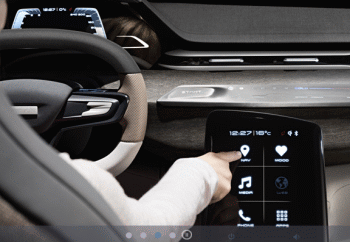
Companies crafting the vehicles of the future say the machines will be safer, more comfortable and infinitely more useful once they’re programmed to drive themselves, which is leading some to drastically change interior layouts.
New technology is being deployed inside mock “cockpits,” and companies are developing prototypes and concepts with tactile surfaces, digital displays, biological sensors in seats, retractable screens and trays, augmented-reality screens and advanced alert systems all aimed at making a driver safer and more comfortable.
“We’re developing a better experience with a new way of enjoying a drive,” said David Degrange, vice president of the cockpit of the future program at automotive parts manufacturer, Faurecia.
Concepts from Faurecia and other companies were on display at the Detroit auto show and come within months of announcements from Ford, General Motors and Fiat Chrysler Automobiles NV about new focuses on autonomous vehicles. Multiple companies aim to have fully autonomous, driverless vehicles on the road by the early 2020s.
Faurecia has a prototype system that measures everything from drivers’ heart rates to how often they blink. The company has a living room-like cockpit that illustrates integrated electronics and smart surfaces. They’ve designed new mobile device connections, surfaces inlaid with LED lights and screens for alerts and interaction, and high-resolution touch screens that swivel and pivot between the driver and passenger seats.
Another supplier, Yanfeng Automotive Interiors, showcased its Experience in Motion (XiM17) concept vehicle, which placed more than 25 “innovations” into the cabin to show how seats might be able to be moved around once the vehicle doesn’t need a human driver.
“People will have more space, and more time to work and play,” said Johannes Roters, Yanfeng CEO. The concept vehicle had several “modes,” all of which triggered a series of shifts within the cockpit that completely reconfigured the interior layout.
Autonomy will “radically” change the inside of a vehicle “in the next 10 years,” said Hans Hendriks, vice president, advanced product development and sales at Yanfeng.
Hendriks said many of the features in the XiM17 can be put in a car in the next five years. Others, like the vehicle’s flat, wooden floor void of the transmission tunnel that requires a center console, are more “exploratory.”
Stephanie Brinley, IHS Automotive Analyst, said the evolution of the cockpit will happen faster as companies zip toward fully autonomous, driverless vehicles. “It’s largely about how do you make the experience better,” she said.
But the more futuristic designs likely won’t be seen on the road within the next two or three decades, Brinley said.
“There’s a tendency to make concepts look really fun or really luxurious,” she said. “The difference could be pretty steep.
“But these concepts are incredibly important for these automakers to evaluate,” said Brinley. “I think that when we get to a point when there are many more autonomous vehicles, there will be an appetite for some people to have an interior that’s on that level.”
Faurecia is focused on integrating design with features that will boost safety in cars that will be on the road in the immediate future.
“(Drivers) need to feel trust, because (they) have a safety cocoon that allows me to do something else,” Degrange said. “That’s something we need to bring to the interior to have this experience.”
Faurecia’s “Intuition” interface mixes functional smart surfaces, decorative surfaces equipped with LED lights, and redeveloped panels and screens to simultaneously boost user experience and safety. The screens will lock the driver out of using the internet, but allow access when passengers pivot the screen to face them.
Another feature would light the side panels and entire dashboard with startling red through LED lights inlaid throughout the surfaces to alert the driver if the vehicle detects approaching emergency vehicles.
The Active Wellness 2.0 system, which hasn’t been put in a vehicle, can track heart rate, breathing rate, blinking, eye movement, expressions, posture, head position, number of yawns, fidgeting and the driver’s grip on the steering wheel. It can also measure the humidity of the cabin. All that data is fed into a system that would adjust the seat, airflow to the cabin or lighting to make the driver more comfortable or alert, and theoretically improve performance.
The features are “connective, adaptive and predictive,” Degrange said, which all adds up to more safety, and in some ways anticipates how a driver might be distracted.
Degrange said comfort and safety go hand-in-hand.
“We need to keep the same level of safety in every new feature,” he said. “Comfort and safety is always linked.”
He sees Faurecia’s designs integrating nicely into automakers’ plans for autonomous interiors. Drivers will always need new alert systems as their focus pivots from looking out the front windshield, and adaptable interfaces will need to move with the passengers.
“We’re at the beginning of something great,” he said. “Whatever happens, we have to sit on something, and we have to have features.”
Read the article in The Detroit News