Vehicle-to-everything turns an EV charging system into a revenue center
By Scott Brierley, Director of Automotive and Strategic Partnerships, Fermata Energy
December 4, 2022
The conversation around EVs is evolving rapidly, giving fleet managers a new way to measure their fleet’s positive impact on their company’s bottom line. What’s the change? EVs are batteries on wheels that enable fleet owners and operators to earn revenue from their local utility while their EVs are parked.
Vehicle-to-everything (V2X) bidirectional charging systems is the technology that makes this possible. This means that EV charging stations for fleet owners and operators are shifting from a cost center to a revenue generator, reducing the cost of acquiring, owning, and operating EVs.
Turn a cost center into a revenue generator
“Standard” unidirectional EV chargers are cost centers, sending power only one way – from grid to vehicle. The company pays for the chargers and installation – and then keeps paying to charge their vehicles. Money flows only one way – out the door.
Bidirectional DC fast chargers are different, changing the power and financial dynamic for EV fleet managers. Fermata Energy’s V2X bidirectional charging platform both charges and discharges EV batteries, making money for the fleet operator.
How? Depending upon the local utility program, the system enables EV fleet operators to: (1) earn revenue by sending energy stored in an EV’s battery to the grid, and/or (2) save on their electricity bill by discharging EV batteries to send energy to their building, avoiding costly peak demand charges. In this context, V2X includes vehicle-to-grid (V2G) and vehicle-to-building (V2B) applications.
The difference between the cost of a unidirectional charger and the revenue/savings generated by bidirectional charging is significant. For example, Figure 1 below illustrates a $45,000 swing in customer value. In fact, the bidirectional charging system can deliver enough profit (either earnings or savings) by year three to pay for the charger.
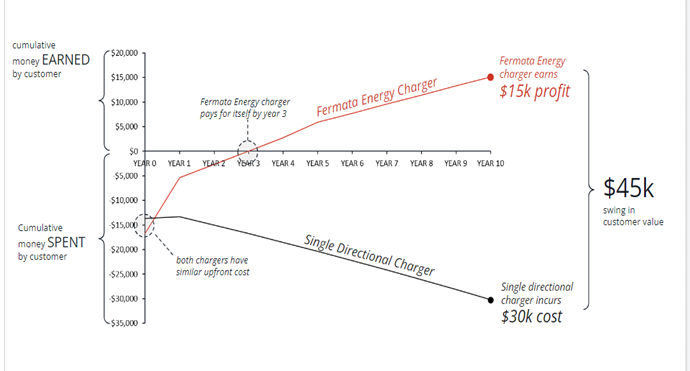
Figure 1. Expected profit swing between unidirectional charging and bidirectional charging. Earnings are dependent upon the utility program and may vary depending upon the utility offering and EV utilization.
All of this can be done without impacting the day-to-day operations of a fleet EV. Fleet managers retain control of their EV utilization and decide whether to have an EV on the road or whether to park it, plug it in, and profit.
What’s more, the system also manages the battery state of charge so that the EV is always ready for the next duty cycle.
The V2X proof points
Fermata Energy has been working with customers, OEMs, and utilities for years, delivering profits for EV fleet managers. Examples include:
- In Rhode Island, one Nissan LEAF paired with a single bidirectional DC fast charger at the Burrillville Wastewater Facility has delivered more than $8,000 in revenue from the local utility. This V2G project uses just one Nissan LEAF paired with the Fermata Energy bidirectional charging system.
- The North Boulder Recreation Center in Boulder, Colorado saves approximately $280 per month, covering the lease cost of the Nissan LEAF, paired with one Fermata Energy bidirectional charging system. This V2B project sends energy stored in the battery to their building to avoid costly peak demand charges. (Colorado is not the highest priced market. Other markets deliver much higher savings.)
We’ve also been witnessing an important trend. Savings through V2B applications on electricity bills are increasing dramatically. Why? Electricity rates and demand charges are increasing rapidly and utilities are under pressure to meet demand. The value of the EV as an energy storage asset is increasing.
What’s required to park it, plug it, and profit?
As fleet managers develop plans to electrify their fleet or add more EVs or chargers, rethinking the value of the EVs and charging systems is increasingly critical. Bidirectional charging can accelerate the timeline and deliver a new ROI.
To realize the benefits of bidirectional charging, three things are required: a bidirectionally-enabled EV, such as the Nissan LEAF, a bidirectional DC fast charger, which costs about the same as a “standard” unidirectional charger, and the V2X energy management platform, which enables fleet managers to decide whether they want to drive or to take advantage of opportunities to earn by discharging the EV battery to the grid or to their building.
To learn more about how fleets are deploying V2X bidirectional charging systems, visit www.fermataenergy.com.
 Turns cost centers into revenue generators
 Costs comparable to one-way chargers
 “No upfront cost” option
 You control your drive time
 Meets UL and IEEE standards
 Fermata Energy partners with OEMs on battery health
Figure 2