Truemag

  • Newsletters
  • Thought Leadership
  • Mobility
  • Safety
  • Work Trucks
  • Videos
  • Home
  • Subscribe
  • Contact Us
  • Media Kit
  • Who We Are

Envisioning the Car of the Future as a Living Room on Wheels

The New York Times

Swiveling seats? Movies projected across the windshield? Social media feeds on the windows?

As driverless car technology develops, companies, design institutes and researchers are asking the question: What does the car of the future look like on the inside?

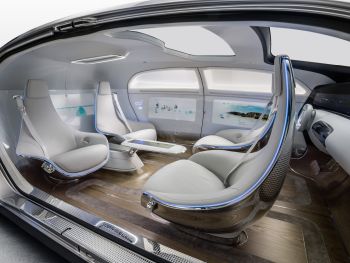
With companies like Google, Uber and others racing ahead to develop fully autonomous vehicles, the era of the driver hunched over the steering wheel may eventually give way to a living room on wheels.

But with its long development lead times, designers are already thinking about how such technology will change the interiors of cars.

When people are in an autonomous vehicle, their expectations will shift, said Hakan Kostepen, executive director for strategy and innovation at Panasonic’s automotive systems unit, a major industry supplier. They will want their personal space to become one of smart mobility, connecting them and relevant information to act upon.

When cars are fully autonomous, how we sit, inform and entertain ourselves will be up for grabs. If steering wheels are no longer needed, how do we best configure seating positions? What should be done with the space now occupied by a dashboard, once a vehicle handles all driving tasks and even decides when it needs to be serviced?

Those are all challenges being taken up by the automotive industry and the schools that supply them with the next generation of designers.

In one concept, social media feeds were displayed on the windows and an all-glass roof, creating what is known as an augmented reality projection, providing contextual information on passing landmarks and approaching sights. As the vehicle drove by a restaurant, reviews of the eatery would be displayed and an online reservation form would appear on the building.

Video games would be integrated into the passing environment. Players could fire weapons at buildings, and then, via a projection on the glass, see the structure go up in digital flames.

Another group envisioned a vehicle’s interior as a constantly changing environment, using variable lighting and temperatures to fit the evolving moods and desires of each occupant, as determined through a sensor analysis of physiological and emotional states.

A third proposal contemplated the use of virtual reality and motion-sensing seats to give occupants the feeling of driving a sports car, even when they were simply riding in a tame autonomous vehicle.

The concepts are not wholly pie in the sky graduates of the ArtCenter have gone on to design vehicles like BMW’s but nevertheless are a step beyond what is being developed by vehicle manufacturers and suppliers, who must take cost, brand reputation and consumer acceptance into account.

Read more of the original article at The New York Times.

Jun 18, 2017connieshedron
I Live on the Road - These are 11 Tools you Should Always Carry in Your Car5 Situations Where Reimbursement Makes Sense
Recent Posts
  • IMPROVLearning: How Comedy, Behavioral Science and AI Improve Fleet Safety
  • Improving Productivity with AI: Turning Fleet Data into Faster Decisions
  • National Safety Council Projects Increased Traffic Crash Risk during Fourth of July Weekend
  • Keep Every Heavy-Duty Maintenance Inspection on Track — Free Fullbay Checklist
  • Gain Data-Driven Insights into Commercial Vehicle Market Trends at Executive Leadership Summit
  • Last Chance to Save: Register for NAFA’s Maintenance Workshop
  • License Plate Cameras Are About to Start Tracking a Lot More Than Just Your Car
  • America’s Heavy EV Problem May End with Drivers Paying More
  • Trends in U.S. Drivers’ Perceptions and Attitudes Toward Vehicle Automation, 2019–2025
  • 2026 NETS Strength IN Numbers Conference: Early Bird Rates!
ASSOCIATION NEWS
Last Chance to Save: Register for NAFA’s Maintenance Workshop
How AFLA Is Positioning Itself for the Future of Fleet Mobility
‘Raise Your Hand and Get Involved’
NAFA Names 2026 Class of Fellows, Honoring Leaders in Fleet Management
Award Winners Honored at NAFA I&E
2026 NAFA I&E Seeks to Change Perceptions, Invigorate Fleets
NAFA Announces Lineup for Media Day at I&E 2026: Industry Leaders to Showcase the Latest Innovations
TECHNOLOGY
Improving Productivity with AI: Turning Fleet Data into Faster Decisions
Fleet Operations Are Changing – The Industry Needs to Evolve With Them
AI-Powered Vehicle Inspections Move Beyond the Checklist
Motive’s New Workforce Capabilities Aim to Improve Performance, Automate Rewards
AI + Human Insight: Why Fleet Leaders Need Both to Win in 2026
NTSB Finds Automation Overreliance Contributed to Two Fatal Ford BlueCruise Crashes
New AI Assistants Automate Fleet Data Analysis, Decision Making and More
CONFERENCES & WEBINARS
2026 NETS Strength IN Numbers Conference: Early Bird Rates!
AFLA 2026 – Keynotes Announced!
Private Fleets Flex at National Private Truck Council Conference
Free NAFA Webinar: Manage Your Fuel Cost Volatility
Registration Now Open for NETS Annual Conference
Early Bird Pricing for AFLA 2026 – Ending June 1
NAFA Online Seminar: Essentials of Fleet Management
INDUSTRY ANNOUNCEMENTS
Union Leasing Becomes Moventum Fleet Management as 70-Year Company Accelerates into Next Phase
Fleetio Wins Innovations Award at NAFA’s 2026 Institute & Expo
WIFM is heading to NAFA!
Cox Automotive Unveils Cox Fleet, Setting a New Standard for Fleet Uptime Nationwide
AFLA Canadian Fleet Professional of the Year Award: Nominations Open!
NAFA Webinar: Kickoff the 2026 100 Best Fleets Contest on December 4!
Join NAFA’s Free Fleet 101 Live Course

Fleet Management Weekly Newsletter Archive
Access to back issues of the FMW newsletter.

FMW Mobility
How mobility is rapidly changing the fleet management landscape.

Newsletter

Subscribe

FMW Fleet Videos
Video clips of industry leaders speaking on a variety of engaging hot topics in fleet.

2014-2020 © Fleet Management Weekly