Truemag

  • Newsletters
  • Thought Leadership
  • Mobility
  • Safety
  • Work Trucks
  • Videos
  • Home
  • Subscribe
  • Contact Us
  • Media Kit
  • Who We Are

For The Automakers, Large-Scale 3D Printing Is The Next Powerful Toolbox

Forbes

“Time is money” is an overused cliché.

Yet, in today’s hypercompetitive technology marketplace, it’s never been truer.

The most sophisticated CAD (Computer Aided Design), fluidynamics and crash simulation programs used by auto manufacturers cannot replace actual testing and the various stage gates in the large-scale manufacturing process, but that will soon change.

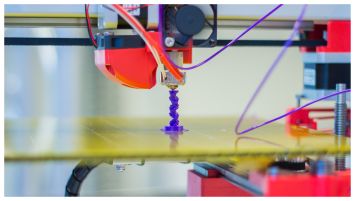
Stamping steel parts still dominates the industry.But large-part 3D printing is quickly racing to the point where it can offer volume producers tangible advantages.

(Also known as “additive manufacturing,” 3D printing produces three-dimensional solid objects directly from digital designs through an additive process, either melting or softening material to produce multiple layers, or through stereolithography which cures a reactive resin with a UV laser or another similar power source.)

It’s a Jetsonian notion, 3D printing. Right out of Spacely Sprockets. You imagine a part or a widget, punch in some numbers on the Widgetmaker and – presto – out comes a fully functioning thing. We’ve arrived at that stage where companies can produce widgets in very short order, make changes to those parts and put them into assembly.

In the short- and medium-term, 3D printing will allow much faster time to market with minor variations added to higher volume cars. In the long term, it will not just yield individual parts, but complex combinations of parts from printing stations working in succession, effectively daisy-chained together, and using multiple materials. This level of complexity and depth will be tempered by many factors, not least of which will be the final cost of the product. For example, a $300,000 McLaren exotic sports car will be far more likely to contain a much higher level of 3D printed components than a $30,000 Ford (NYSE:F) Fusion, considering both the comparative costs and the vastly higher customization expected of an exotic car versus a family car.

Like all new technologies, materials and manufacturing processes, the leading edge becomes ever more democratized over time and Ford is now advancing a new partnership with Stsratasys (NASDAQ:SSYS) to print one-piece parts for prototyping and production. It will be some time before high-volume production parts are made from any 3D printing exercise, but Global Industry Analysts, Inc. predicts the total 3D printing market market will reach nearly $10 billion by 2020.

Yet, 3D printing is not entirely new. Aerospace, the military, the tech business, medical device companies and motorsports have been employing it for small parts and prototyping for roughly 15 years. In fact, Ford and Ganassi Racing’s winning prototype at the 24 Hours of Daytona back in 2015 used an intake manifold created using 3D printing as a last-minute iteration for that car’s EcoBoost V6 engine.

Read more of the original article at Forbes.

Mar 11, 2017connieshedron
How to Cut Down on Fuel UsageSelf-Driving Cars will Look Different: for one, no Man-Eating Grilles
Recent Posts
  • IMPROVLearning: How Comedy, Behavioral Science and AI Improve Fleet Safety
  • Improving Productivity with AI: Turning Fleet Data into Faster Decisions
  • National Safety Council Projects Increased Traffic Crash Risk during Fourth of July Weekend
  • Keep Every Heavy-Duty Maintenance Inspection on Track — Free Fullbay Checklist
  • Gain Data-Driven Insights into Commercial Vehicle Market Trends at Executive Leadership Summit
  • Last Chance to Save: Register for NAFA’s Maintenance Workshop
  • License Plate Cameras Are About to Start Tracking a Lot More Than Just Your Car
  • America’s Heavy EV Problem May End with Drivers Paying More
  • Trends in U.S. Drivers’ Perceptions and Attitudes Toward Vehicle Automation, 2019–2025
  • 2026 NETS Strength IN Numbers Conference: Early Bird Rates!
ASSOCIATION NEWS
Last Chance to Save: Register for NAFA’s Maintenance Workshop
How AFLA Is Positioning Itself for the Future of Fleet Mobility
‘Raise Your Hand and Get Involved’
NAFA Names 2026 Class of Fellows, Honoring Leaders in Fleet Management
Award Winners Honored at NAFA I&E
2026 NAFA I&E Seeks to Change Perceptions, Invigorate Fleets
NAFA Announces Lineup for Media Day at I&E 2026: Industry Leaders to Showcase the Latest Innovations
TECHNOLOGY
Improving Productivity with AI: Turning Fleet Data into Faster Decisions
Fleet Operations Are Changing – The Industry Needs to Evolve With Them
AI-Powered Vehicle Inspections Move Beyond the Checklist
Motive’s New Workforce Capabilities Aim to Improve Performance, Automate Rewards
AI + Human Insight: Why Fleet Leaders Need Both to Win in 2026
NTSB Finds Automation Overreliance Contributed to Two Fatal Ford BlueCruise Crashes
New AI Assistants Automate Fleet Data Analysis, Decision Making and More
CONFERENCES & WEBINARS
2026 NETS Strength IN Numbers Conference: Early Bird Rates!
AFLA 2026 – Keynotes Announced!
Private Fleets Flex at National Private Truck Council Conference
Free NAFA Webinar: Manage Your Fuel Cost Volatility
Registration Now Open for NETS Annual Conference
Early Bird Pricing for AFLA 2026 – Ending June 1
NAFA Online Seminar: Essentials of Fleet Management
INDUSTRY ANNOUNCEMENTS
Union Leasing Becomes Moventum Fleet Management as 70-Year Company Accelerates into Next Phase
Fleetio Wins Innovations Award at NAFA’s 2026 Institute & Expo
WIFM is heading to NAFA!
Cox Automotive Unveils Cox Fleet, Setting a New Standard for Fleet Uptime Nationwide
AFLA Canadian Fleet Professional of the Year Award: Nominations Open!
NAFA Webinar: Kickoff the 2026 100 Best Fleets Contest on December 4!
Join NAFA’s Free Fleet 101 Live Course

Fleet Management Weekly Newsletter Archive
Access to back issues of the FMW newsletter.

FMW Mobility
How mobility is rapidly changing the fleet management landscape.

Newsletter

Subscribe

FMW Fleet Videos
Video clips of industry leaders speaking on a variety of engaging hot topics in fleet.

2014-2020 © Fleet Management Weekly