By Ed Pierce, Fleet Brand Acceleration
February 11, 2026
For years, marketing within the automotive fleet supply ecosystem—OEM partners, upfitters, telematics providers, logistics companies, maintenance networks, fuel and charging providers, software platforms, and service specialists—has largely been viewed as a communications and lead-generation function. Its primary mission has been to support sales, promote products, and raise awareness of new capabilities.
That model is no longer sufficient in 2026.
Fleet buyers today are more digitally sophisticated, more risk-conscious, and better informed than ever. They expect suppliers to understand the operational realities of fleet management, anticipate regulatory and technology shifts, and deliver meaningful insight—not just product information. At the same time, competition has intensified across nearly every fleet category, and differentiation based solely on features or price has become increasingly difficult.
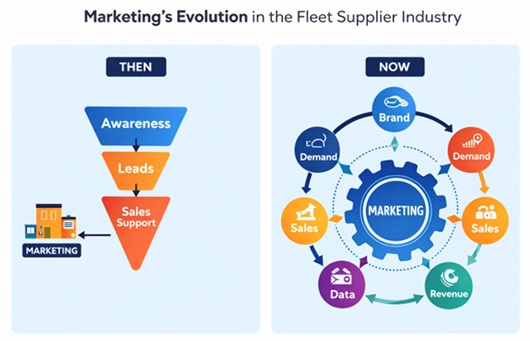 As a result, B2B marketing across the automotive fleet supplier community is undergoing a fundamental transformation. Marketing is becoming a true driver of strategic growth, shaping how companies position themselves, go to market, and generate revenue. Data sits at the center of this evolution, amplified by AI, advanced analytics, and increasingly integrated technology stacks.
The New Mandate for Marketing in the Fleet Supplier Ecosystem
In the past, fleet supplier marketing teams focused on a familiar set of activities, including producing brochures and case studies, managing websites, running trade shows and sponsorships, generating leads, and supporting product launches. While these responsibilities remain important, they no longer represent marketing’s highest value.
 In 2026, leading fleet suppliers treat marketing as a core strategic function. Marketing leaders now collaborate with sales, product, finance, and operations to shape business direction. Their role extends beyond campaign execution to include defining ideal customer profiles and priority verticals, shaping market positioning and category narratives, delivering customer and competitive intelligence, influencing pricing and solution packaging, and driving both near-term pipeline and long-term brand equity.
This shift reflects a growing recognition that sustainable growth is not merely about selling more—it is about aligning the entire organization with the right customers, problems, and value propositions. Marketing is uniquely positioned to orchestrate that alignment.
Data as the Foundation of Modern Fleet Marketing
Fleet operations generate vast volumes of data, including vehicle utilization, maintenance activity, telematics signals, routing patterns, safety events, fuel and energy consumption, downtime, and lifecycle costs. Increasingly, fleet suppliers are learning to combine this operational intelligence with marketing and customer interaction data to inform strategic decisions.
 Brand and positioning efforts now rely on audience research, sentiment analysis, and share-of-voice metrics to guide how suppliers define their market presence. Rather than relying solely on intuition, brand strategy is informed by clear evidence of what buyers care about, how they describe their challenges, and where competitors fall short.
Demand creation is guided by intent data, behavioral signals, and account-level engagement scoring that reveal which fleets are actively researching solutions, which topics they care about, and where they are in the buying journey. Campaigns become more focused, timely, and relevant.
Digital experience and content strategies are increasingly personalized based on user behavior, industry segment, and prior interactions. For example, a municipal fleet manager may see different messaging than a private last-mile delivery operator—even when visiting the same webpage.
 Product and solution marketing is also becoming more data driven. Usage patterns, support data, customer feedback, and win/loss analysis inform how solutions are packaged, positioned, and messaged. Marketing plays a critical role as the voice of the customer in product roadmap discussions.
The result is a connected marketing ecosystem in which data serves as the unifying force. As teams operate from a shared intelligence foundation, traditional silos between brand, demand, digital, and product marketing continue to erode.
The Rise of Hybrid Marketers
Fleet marketing was once split between creative storytellers and analytically minded performance marketers. In 2026, that divide is rapidly disappearing.
 Today’s most effective marketing teams expect professionals to blend creativity with data fluency. Modern fleet marketers translate complex operational concepts into compelling stories, interpret dashboards and attribution models, understand CRM and automation platforms, collaborate closely with sales and product teams, and use data to continuously test and optimize.
This hybrid skill set reflects the reality that fleet marketing must both inspire and deliver. Emotional resonance remains essential in a relationship-driven industry, but it must be paired with measurable business impact. Suppliers that invest in continuous learning, cross-functional exposure, and modern tools are better positioned to build these hybrid teams.
AI’s Expanding Role: From Efficiency Tool to Strategic Engine
Early adopters of AI in fleet marketing focused primarily on productivity gains, including drafting content, summarizing research, generating ideas, and automating repetitive tasks. Those benefits remain valuable, but AI’s role is now expanding into more strategic areas.
 By 2026, AI will increasingly provide predictive insights into which accounts are most likely to buy, which solutions they may need next, and when outreach is most effective. It enables real-time campaign optimization by automatically adjusting messaging, channels, and budget to improve performance. AI-generated insights are shared across marketing, sales, and product teams, creating a common understanding of customer behavior and market trends. It also enables scalable personalization, delivering highly tailored messaging to thousands of accounts with minimal manual effort.
Crucially, AI is not replacing human relationships in fleet marketing. Instead, it enhances them by removing administrative friction and surfacing deeper insights, freeing teams to focus on strategic, consultative engagement.
Revenue-Centric Measurement Becomes the Standard
Fleet supplier executives increasingly expect marketing to demonstrate a clear contribution to growth. While impressions and clicks still provide diagnostic value, they are no longer sufficient indicators of success.
 In 2026, mature organizations emphasize marketing-sourced and marketing-influenced pipelines, funnel-stage conversion rates, depth of account engagement, customer lifetime value, and the impact of marketing on retention and expansion.
Attribution remains imperfect—particularly in long, complex fleet buying cycles—but progress continues through multi-touch models and tighter integration between CRM and marketing automation platforms. The emphasis is shifting from proving perfection to demonstrating direction: showing that marketing investments drive measurable business momentum.
What This Means for Automotive Fleet Industry Suppliers
 For suppliers across the fleet ecosystem, this evolution has clear implications. Marketing leadership must be elevated and embedded in strategic planning. Technology stacks must be integrated to support data-driven decision-making. Content strategies must move beyond product features to insight-driven thought leadership. Account-based approaches should become central to growth strategies. And organizational culture must recognize marketing as a growth engine, not a service function.
Marketing as Competitive Advantage
 By 2026, the most successful automotive fleet suppliers will no longer ask, “How can marketing support sales?” Instead, they will ask, “How can marketing help determine where we compete, how we win, and how we grow?”
The transformation of marketing into a strategic growth driver is not a passing trend—it is a structural shift. Suppliers that embrace this reality will be better equipped to navigate market volatility, differentiate themselves in crowded categories, and build enduring customer relationships. Those that do not risk falling behind competitors who understand that in today’s fleet industry, marketing is no longer just about telling the story—it is about shaping the future.
 About the author
Fleet marketing expert and consultant Ed Pierce is an editor at Fleet Management Weekly. He can be reached at 484-957-1246 or [email protected].