
By Brett Carlson, CEO, ServiceUp
April 8, 2026

Brett Carlson, ServiceUp CEO
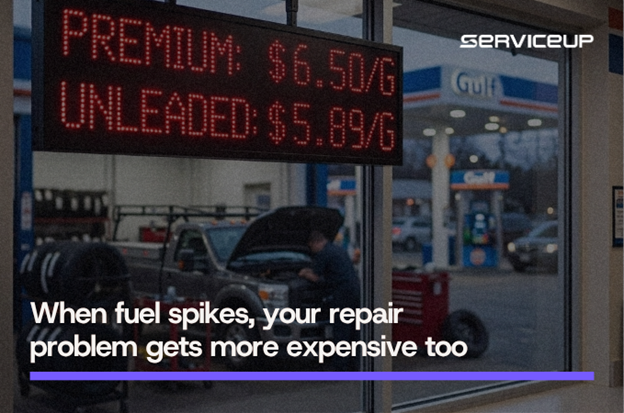
Right now, fuel cost is the number everyone is watching. And for good reason.
Diesel prices have surged sharply in recent months, driven by geopolitical instability in the Middle East and global supply disruption. Fleet managers did not cause this and cannot negotiate their way out of it.
The standard response is predictable: route optimization, idle reduction, driver coaching. All valid. But these are marginal gains against a market force you cannot move. What most fleets are not seeing is the downstream effect rising fuel costs have on something they can control: their repair and maintenance process.

How rising fuel costs trickle into repair
Motor vehicle maintenance and repair costs rose 5.4% in 2025, roughly double the general inflation rate. That trend has continued into 2026. And the same geopolitical instability driving diesel prices higher is disrupting the supply chains that move automotive components around the world, meaning the two pressures share the same root cause.
The trickle-down runs in three directions. First, preventive maintenance itself costs more when oil prices rise. Engine oil, transmission fluid, coolant, and lubricants are petroleum-derived and track crude closely. Second, the parts needed for routine service travel via diesel-powered freight, which passes its fuel costs on. Third, shops run service vans and parts pickups at elevated fuel costs, overhead that feeds directly into the labor rate you pay. When fuel spikes, the bill for a routine oil change quietly rises too, not because the work changed but because every input to it costs more.

On top of that, a poorly maintained vehicle burns more fuel. Underinflated tires, dirty air filters, worn spark plugs, degraded oil. None of these trigger a repair event until they become serious enough to take a vehicle down. But every day they go unaddressed, they add cost to your fuel bill. At $4.50 a gallon, that daily drag is worth more than it has ever been.
The downtime cost nobody is calculating
When a vehicle is offline, the other vehicles covering its routes burn more fuel. Diesel is running between $4.10 and $4.60 per gallon in most regions, so the repair event does not just cost what is on the invoice. It costs the excess fuel burn accumulating across the rest of the fleet while that vehicle sits.
According to recent survey data from BBM Research commissioned by ServiceUp, 72% of fleet operators deal with repair headaches weekly or monthly, and 44% cite parts delays as a top problem. Parts delays mean a vehicle could sit for a week or more, burning nothing while the rest of your fleet compensates.
The current environment makes this worse. Diesel prices have increased 46% since early February, driven by the same geopolitical disruption tightening parts availability. The fleet manager waiting on a brake component is feeling the downstream effect of the same story driving up fuel prices across the rest of the fleet.
What the numbers actually look like
Augusta, Georgia recently reported diesel hitting $5.15 per gallon against a budgeted $3.50, a variance already threatening its spending plan. Fuel can account for up to 35% of a fleet’s total operating budget. Repair and maintenance is another major line. When both are rising for the same underlying reasons, letting repair run reactively compounds a cost problem you are already losing ground on.
What you can do about it
Treat repair turnaround as a fuel cost metric. Every additional day a vehicle is offline has a measurable cost in excess fuel burn across the rest of the fleet. That number should factor into how quickly repairs get authorized and which providers you use.

Hold the line on preventive maintenance schedules rather than deferring them under operational pressure. Pulling a vehicle for scheduled service today is cheaper than running it degraded for three more weeks and absorbing a breakdown. When pump prices are elevated, the fuel efficiency gains from keeping vehicles in good mechanical condition are a direct offset against a cost you cannot otherwise reduce.
And demand predictability from your repair process, not just lower prices. As vehicles age and maintenance slips, fuel efficiency drops alongside reliability. A repair that returns a vehicle to service in two days is worth more than a cheaper repair that takes seven. The fuel cost of that extended downtime often exceeds the savings on the invoice.
You cannot control the price of diesel. You can control how long your vehicles stay off the road when something goes wrong.
Fuel costs are an external pressure you absorb. Repair and maintenance is the internal process you manage. Right now, how well you manage the second one has a direct and measurable impact on how much the first one costs you.
ServiceUp is a fleet repair management platform that helps operators reduce vehicle downtime, standardize repair costs, and maintain budget predictability. Survey data referenced in this article is sourced from BBM Research’s Fleet Operator Survey conducted December 2025 through January 2026 across 80 senior fleet decision-makers.