By Lori Rasmussen, President, PARS
February 4, 2026

Lori Rasmussen, President, PARS
For more than two decades, PARS has had a singular focus: helping fleet managers move vehicles safely, efficiently, and in strict alignment with their operational and policy requirements. We built our reputation on professional driveaway services and a deep understanding of the realities fleet teams face every day—tight timelines, budget scrutiny, compliance pressures, and the need for absolute reliability.
Today, I’m proud to share how that mission has expanded in a meaningful and transformative way. PARS has been acquired by RPM, a company with extensive experience in large-scale carrier transport, finished vehicle logistics, and sophisticated transportation technology. This is more than a change in ownership. It is a strategic step forward that redefines what fleet vehicle logistics can and should look like.
From the perspective of fleet professionals, this acquisition shifts the conversation. It moves us beyond a traditional, mode-specific approach to vehicle relocation toward a full-spectrum logistics platform designed to reflect how fleets operate today.
Why This Acquisition Matters to Fleet Managers
Fleet operations have changed dramatically in recent years. Vehicles are more diverse. Deployment models are more complex. And the margin for error continues to shrink. Fleet managers are being asked not only to move vehicles but also to justify when, how, and why those moves occur—and to do so with greater transparency than ever before.
 Historically, fleet relocation services often focused on a single method, most commonly driveaway. While driveaway remains a vital and effective solution, it is no longer sufficient on its own for many modern fleet programs. Carrier transport, hybrid moves, storage coordination, and lifecycle-driven redeployments are increasingly part of the mix.
The acquisition of PARS by RPM directly addresses that reality.
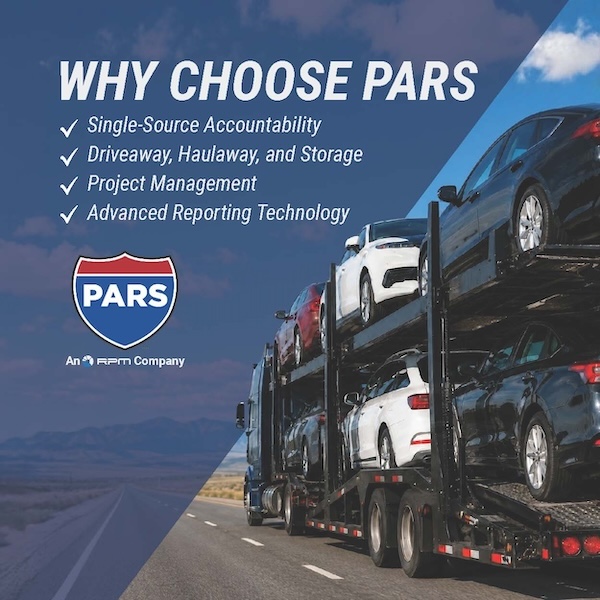
By combining PARS’s deep expertise in fleet relocation management with RPM’s scale in carrier transport and logistics technology, we can now support multimodal vehicle movement strategies through a single, accountable partner. That integration allows fleet managers to focus on outcomes rather than on managing multiple vendors and disconnected processes.
From Driveaway Specialist to Full-Spectrum Fleet Logistics Platform
PARS will always be proud of its driveaway roots. That expertise remains central to who we are and how we serve our customers. What has changed is the scope of what we can now deliver.
 RPM brings decades of experience managing high-volume carrier transport operations, along with the systems and carrier relationships needed to execute them efficiently. When combined with PARS’s fleet-specific execution model—built on compliance, documentation, and service discipline—the result is a logistics platform capable of supporting complex vehicle movements at scale.
For fleet managers, this means:
- The ability to select the most appropriate transport mode for each move
- Seamless coordination between driveaway and carrier solutions
- Improved visibility across the entire relocation process
- Reduced friction between planning and execution
Instead of asking, “Who do I call for this type of move?” fleets can now work with one partner who understands the full picture and can execute accordingly.
Continuity Where It Matters Most
One of the first questions we heard from customers after the acquisition was simple yet important: Will anything change in our day-to-day experience?
The answer is no—at least not in the ways that matter most.
 PARS continues to operate under its own name, with the same leadership team, customer service professionals, and operational processes our customers trust. The relationships, institutional knowledge, and service culture that define PARS remain unchanged.
What has changed is the strength of the infrastructure supporting that team.
Behind the scenes, RPM’s carrier network, logistics expertise, and technology capabilities expand our capacity and resilience. This means better options during peak demand, greater flexibility when conditions change, and more consistent execution across large or geographically dispersed programs.
The Power of Experience, Backed by Scale
Technology and capacity are essential, but fleet logistics is ultimately a people-driven business. One of PARS’s greatest strengths has always been the depth of experience across our customer service and operations teams.
 Our professionals have managed some of the fleet industry’s most complex vehicle relocation projects—multi-location deployments, time-critical redeployments, regulatory-driven government moves, and large-scale commercial transitions. With RPM’s logistics infrastructure behind us, that expertise is now supported by greater carrier capacity and operational reach.
The impact of that combination has been immediate. In a recent PARS customer survey conducted within the first month of RPM assuming carrier operational fulfillment, the percentage of customers reporting they were “extremely satisfied” increased by approximately 140 percent. That early feedback reinforces what we believed from the outset: integrating carrier scale with fleet-specific execution strengthens performance in measurable ways.
What This Means for Different Fleet Segments
Private and Commercial Fleets
Private fleets often operate a diverse mix of vehicles across multiple regions, with utilization and cost efficiency top of mind. The expanded PARS–RPM platform enables more strategic mode selection—balancing driveaway and carrier transport to reduce wear, manage mileage, and optimize the total cost of movement.
Fleet managers gain a single partner capable of scaling with their program while maintaining consistency and accountability.
Government and Public Sector Fleets
 Government fleets face unique challenges, including strict procurement rules, compliance requirements, and heightened documentation standards. PARS’s long history in this space remains a core advantage, now reinforced by RPM’s ability to handle larger volumes and more complex routing requirements without sacrificing transparency.
Multi-Location and National Programs
For fleets operating across multiple locations, consistency is critical. The combined PARS–RPM organization delivers standardized execution, supported by a national carrier network—reducing fragmentation and improving predictability across regions.
Reflecting a Broader Shift in Fleet Logistics
 This acquisition is not just about two companies coming together. It reflects a broader trend in the fleet industry: the shift toward end-to-end logistics solutions from trusted partners.
Fleet managers are increasingly seeking providers who understand both the operational details and the strategic implications of vehicle movement. They want partners who can manage vehicles from factory to field—and back again—while aligning logistics decisions with broader business goals.
By joining RPM, PARS is positioned squarely within that future.
Looking Ahead
Our commitment to customers remains unchanged. What has changed is our ability to support them as fleet operations grow more complex and expectations continue to rise.
 The acquisition of PARS by RPM strengthens what our customers already value—service integrity, accountability, and expertise—while expanding what we can deliver through greater scale, technology, and carrier capability.
For fleet managers navigating the next phase of vehicle logistics, this is not just an evolution. It is an opportunity to work with a partner built for what lies ahead.